

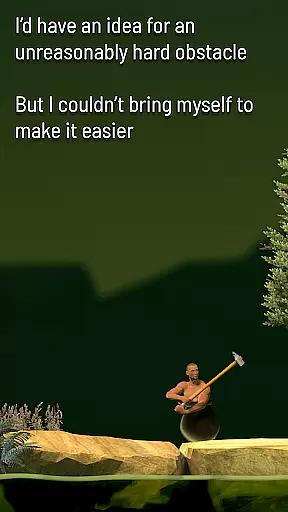
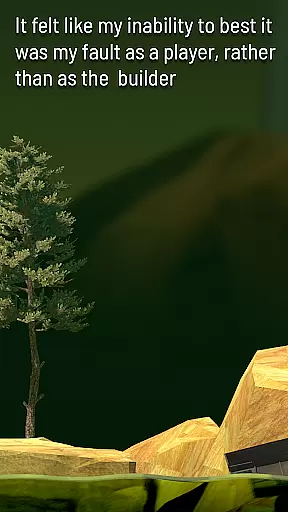
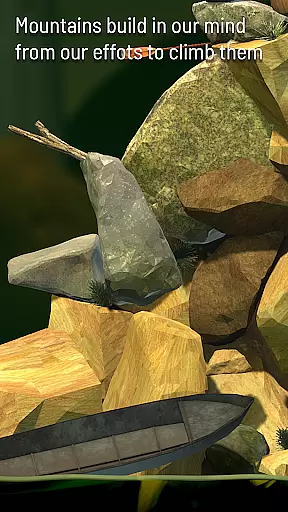
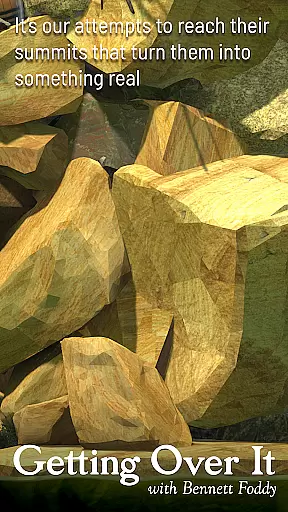

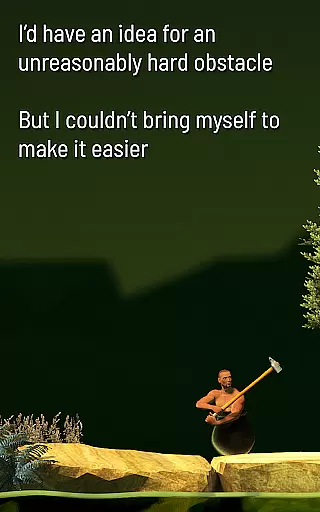




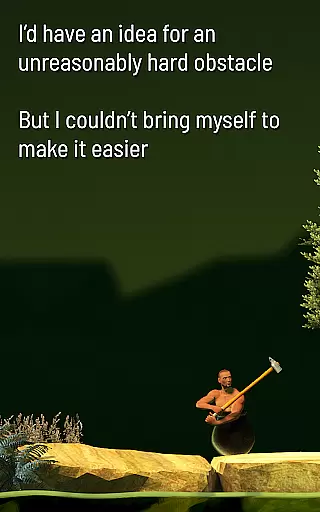



Getting Over It with Bennett Foddy is a challenging simulation game that tests players' patience and perseverance. In this game, you control a character equipped with only a hammer and a pot, aiming to climb an enormous mountain. The gameplay is intentionally designed to be difficult, offering between 2 to ∞ hours of agonizing yet rewarding experience. With each attempt, players must use their skills to jump, swing, climb, and even fly to reach the summit.
The game stands out with its unique mechanics and philosophical commentary provided by the creator, Bennett Foddy. As you progress, you'll encounter great mysteries and a wonderful reward for those who manage to reach the top. Despite frequent setbacks where you may lose all your progress, the game encourages a deeper understanding of frustration and persistence, making it ideal for gamers seeking a true challenge.
One of the most notable features of Getting Over It is its minimalist control scheme. Players move the hammer using only the mouse, requiring precision and practice to master various movements such as jumping, swinging, and climbing. This simplicity in controls contrasts sharply with the complexity of the challenges presented, creating a steep learning curve that rewards skilled players.
Beyond its core mechanics, the game offers profound philosophical observations about the nature of struggle and perseverance. These insights are delivered through narration by Bennett Foddy himself, adding depth to the overall experience. Additionally, the game boasts a unique aesthetic and sound design that complements its punishing difficulty, ensuring that every small victory feels significant. The combination of these elements results in a memorable and thought-provoking gaming experience.
In simulation games, the economic system plays a crucial role in providing an immersive experience. Getting Over It with Bennett Foddy offers a unique take on this aspect by incorporating a minimalist yet profound economic model centered around a simple tool - the hammer. The game challenges players to think strategically about how they use their only resource.
The dynamic feedback mechanism in the game is exceptional. As players climb the mountain, every swing of the hammer and every decision made directly impacts their progress. This creates a responsive environment where each action has significant consequences, teaching players to adapt their strategies continuously.
Players benefit from this design as it encourages problem-solving skills and patience. The lack of traditional economic elements like currency or trade is replaced by a more primal form of economy based on physical effort and perseverance. This approach provides a fresh perspective on what constitutes an 'economic system' in gaming.
The true value lies in the emotional and psychological investment players make. Losing progress due to a misstep forces players to reflect on their strategies and decisions, offering a deeply personal connection to the game's economic structure. This results in a uniquely rewarding experience that resonates long after the play session ends.
Resource management is at the heart of many simulation games, and Getting Over It presents a masterclass in balancing limited resources with player ingenuity. In this game, your sole resource is a hammer, which must be used efficiently to navigate through challenging terrains.
The balance achieved in resource management is remarkable. Players quickly learn that brute force alone won't lead to success; instead, finesse and precision are required. Each movement needs careful consideration, making every small victory feel earned and significant.
This setup benefits players by fostering a deep sense of accomplishment. The scarcity of resources forces players to think creatively and develop innovative solutions to overcome obstacles. This not only enhances engagement but also promotes critical thinking and adaptability.
Ultimately, the resource management in Getting Over It teaches valuable lessons about efficiency and strategy. By limiting tools and emphasizing skill, the game creates a balanced ecosystem where every action counts, leading to a fulfilling and thought-provoking experience for players seeking both challenge and insight.
Unique gameplay mechanics
Thought-provoking commentary
Challenging and rewarding
Minimalist control scheme
Great sense of achievement
Extremely difficult
Frequent setbacks
Not for casual gamers
Repetitive at times
Can be frustrating

Your Empire Awaits: Forge a Realm in This City-Building Idle Game!
 4.80
4.80
Multiverse in shambles? There's a goat for that. Play on mobile now!
4.60
ASMR Cooking Minigames to calm & relax
4.50
It’s not a bug, it’s a feature
4.20
Cook in the kitchen, Serve food: Manage the dash fever in my restaurant games!
4.20
Play and earn real BTC rewards!
4.50
The original idle game. Bake cookies to rule the universe!
4.50
Divine casual-strategy Sandbox game about Gods, Civilisations and Faith!
4.50
Collection of relax mini games: Skincare, makeup, makeover, decorating and more
4.00
Makeup, dress up and skincare for your princess fashion
4.70
An Atmospheric Vehicle Adventure Game
4.60
Start painting, match paint, merge colors and get creative in this coloring game
4.60
Life Business empire rich game. Boss millionaire idle games. Idle office tycoon
4.60
Laugh, play, take care, learn and relax with the cutest virtual friend
4.50
Join storage auction! Manage your pawn shop! Become an auction tycoon!
4.40
Raise crops and animals in this farming simulator!
4.20
Experience the ultimate vehicle simulator with realistic soft-body physics
4.20
Rediscover your engineering creativity in this bridge building masterpiece.
4.10
start a cult from your phone in this cozy idle-clicker game.
4.3


User Reviews